Cannabis plants rely on xylem and phloem to transport water, nutrients, and sugars. Xylem moves water and minerals from the roots upward, while phloem distributes sugars and nutrients both up and down to support growth and flowering. These systems are vital for healthy plants, strong stems, and higher yields.
Key points:
- Xylem: Transports water and minerals; powered by transpiration.
- Phloem: Delivers sugars and nutrients to growing areas; supports bud development.
- Vascular bundles: Xylem is central (strength + water transport); phloem is near the stem's outer edge (sugar movement).
- Grower tips: Maintain proper watering, light, and humidity to prevent stress. Avoid damaging vascular tissues during training.
Healthy vascular systems ensure plants grow efficiently and produce dense, resin-rich buds. Genetics also matter - choose seeds with traits like strong stems and high nutrient uptake for better results.
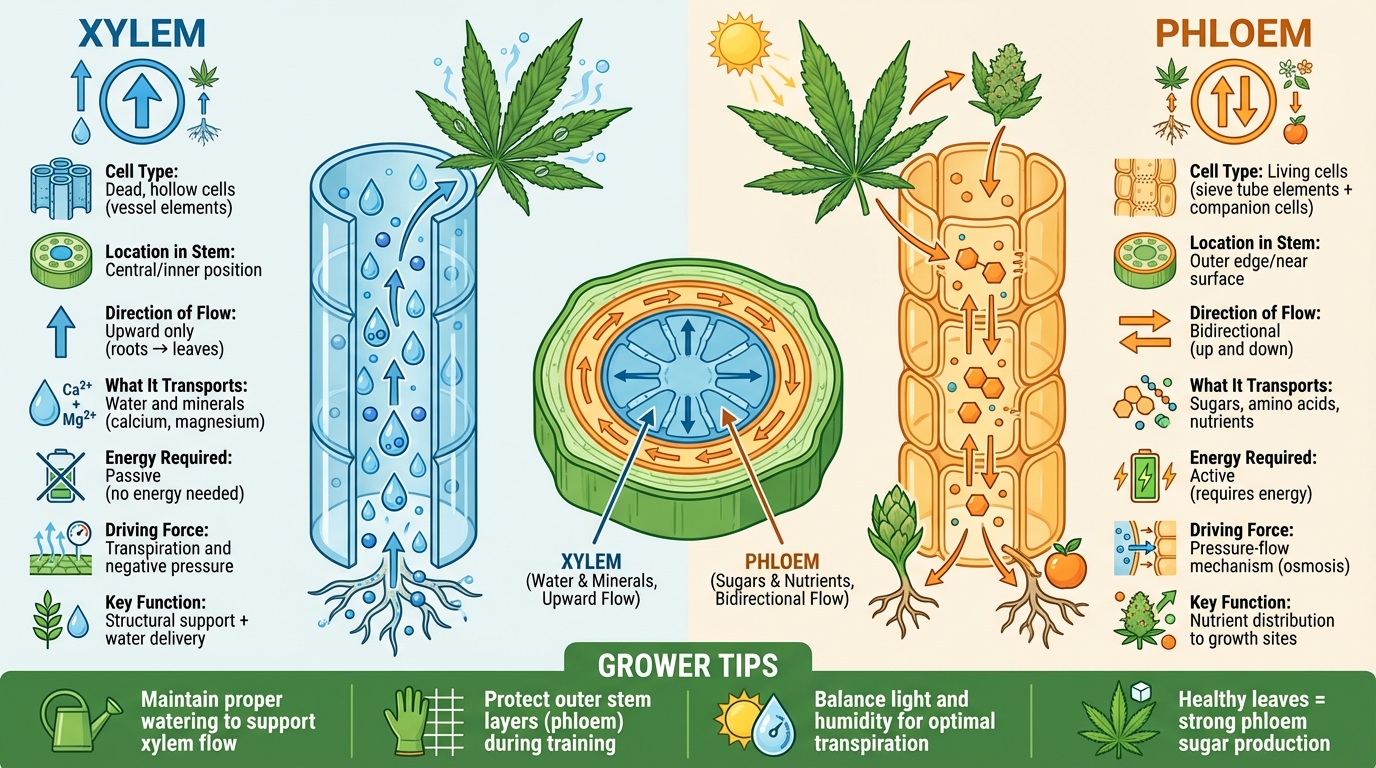
Xylem vs Phloem: Cannabis Plant Vascular System Comparison
How Xylem and Phloem Work in Cannabis Plants
Xylem: Moving Water and Minerals
Xylem tissue consists of long, hollow, dead cells called vessel elements. These elements stack end-to-end to form continuous tubes that run from the roots, through the stems and branches, and into the leaf veins. Water enters the roots via osmosis, passing through the Casparian strip, which controls what gets into the xylem. Once inside, water moves upward thanks to cohesion and adhesion, forming a continuous column. This movement is powered by transpiration.
Transpiration is the process where water evaporates from leaf stomata, creating a negative pressure that pulls water and dissolved minerals - like calcium and magnesium - from the roots upward. This system doesn’t require the plant to use energy since it operates passively. The narrow structure of xylem tubes helps maintain the water column and minimizes the effects of air bubbles (embolisms), ensuring the system remains functional even under challenging conditions.
For growers, maintaining steady transpiration is critical. Proper light, moderate temperatures (around 70–80°F), and balanced humidity levels support consistent xylem flow, ensuring less-mobile nutrients like calcium reach the plant’s canopy. Overwatering can suffocate roots and reduce uptake, while underwatering can cause wilting and increase the risk of cavitation. Extreme heat or very low humidity can speed up transpiration, potentially leading to nutrient imbalances if roots can’t keep up with the demand.
Phloem: Distributing Sugars and Nutrients
Unlike xylem, phloem is made up of living cells. It includes sieve tube elements connected end-to-end with perforated walls, as well as companion cells that help load and unload sugars. Sugars produced by photosynthesis in mature leaves are actively loaded into the phloem, increasing the sugar concentration. Water from nearby xylem enters the phloem through osmosis, creating internal pressure that drives the sap toward "sink" tissues - areas like growing roots, new shoots, or developing buds that need energy.
At these sink sites, sugars are unloaded to fuel respiration, growth, or storage. As the pressure drops, the sap continues moving along the pressure gradient. This pressure-flow mechanism allows the phloem to transport nutrients both upward and downward, depending on where they’re needed. During vegetative growth, the flow is mainly directed downward to support roots and lateral shoots. When the plant enters flowering, most of the sap is directed toward the buds, which demand sugars, amino acids, and other nutrients.
Healthy, mature leaves are essential for producing enough sugars to fuel rapid root expansion, sturdy stem growth, and dense bud development. Removing too many leaves early on can reduce sugar production, so growers should focus on removing only shaded or non-essential leaves to maintain a strong phloem flow. This balance is critical for supporting the plant’s vascular processes as it matures.
Where Xylem and Phloem Are Located in Cannabis Stems
The placement of xylem and phloem in cannabis stems plays a vital role in both structural support and nutrient transport. As the plant grows and stems thicken, vascular bundles expand and may merge into more continuous rings. Additional fibers develop around these bundles, increasing stem strength and giving it a woody texture.
In branches, xylem delivers water and minerals outward, while phloem brings sugars to areas that need them. In leaves, vascular bundles form the visible veins, with xylem typically located on the upper side of the vein and phloem on the lower side. These veins connect back to the stem through the petioles. This arrangement explains why damage to the outer layers of a stem (where the phloem is located) can severely disrupt sugar transport, even if the deeper xylem remains partially intact.
When training plants using methods like topping, supercropping, or low-stress training (LST), it’s important to avoid crushing the outer layers of the stem. Preserving the phloem ensures sugars can continue moving through the plant. If the stem is damaged, leaving enough tissue intact allows the xylem and phloem to reconnect and form callus tissue, restoring the flow of water and nutrients.
Xylem and Phloem - Transport in Plants | Biology | FuseSchool

Xylem and Phloem During Different Growth Stages
Understanding how xylem and phloem adapt throughout a plant's growth stages reveals the dynamic role of vascular systems in meeting the plant's changing needs.
Seedling and Early Vegetative Stages
In the early days after germination, the xylem establishes critical water pathways, connecting the taproot to the hypocotyl, cotyledons, and first true leaves. This initial network is delicate - overwatering can suffocate roots and damage vessels, while drought can lead to vessel collapse or embolisms. As soon as the first true leaves begin photosynthesis, the phloem activates, transporting sugars to the growing root tips and apical shoot to fuel cell division and growth.
Seedlings thrive in lightly moist media, with relative humidity around 60–70% and gentle airflow to protect the fragile xylem. Many growers in the U.S. keep nutrient strength low (around 0.4–0.6 mS/cm above the base water) to avoid burning young roots and ensure smooth vascular uptake. As plants transition to early vegetative growth, xylem vessels expand in both number and diameter throughout the taproot, lateral roots, and main stem. This enhanced network improves water transport, supports thicker stems, and strengthens cell walls, enabling plants to handle brighter light, stronger airflow, and higher vapor pressure deficit (VPD).
Vegetative Growth and Canopy Development
During vigorous vegetative growth, the expanding canopy significantly increases transpiration, requiring a denser xylem network to deliver water and minerals to the growing number of leaves and branches. At the same time, the phloem moves larger quantities of sugars from fan leaves to side branches and roots, driving horizontal growth and root development. Growers often respond by increasing irrigation frequency, slightly raising nutrient levels, and ensuring consistent calcium and potassium to maintain vascular strength and support rapid canopy expansion.
When training plants during this stage, it's essential to protect the vascular system. Use sterile tools for clean cuts, avoid sharp bends that could collapse stems, and support bent branches with ties. Techniques like topping can redistribute auxin and sugars to side branches without damaging the main xylem channels. Low-stress training (LST) gently redirects vascular pathways while keeping them intact. Supercropping, which temporarily pinches xylem and phloem, encourages callus formation to thicken stems but should be done carefully to avoid long-term blockages. As the plant transitions to reproductive growth, its vascular focus shifts to prioritize bud development.
Flowering Stage and Bud Formation
At the start of flowering, xylem demand increases due to the larger leaf area and the energy required to initiate buds. Meanwhile, the phloem shifts its focus toward floral sites, which become major sinks for sugars and photoassimilates. Many U.S. growers reduce nitrogen levels at this stage while increasing phosphorus and potassium to promote flower development and maintain vascular health, ensuring sufficient carbohydrate delivery to the buds.
During peak bloom, the phloem directs sugars and amino acids to maturing buds for cannabinoid and terpene production, while the xylem continues to supply water and minerals to sustain photosynthesis and turgor pressure in both leaves and buds. If VPD or light intensity is too high without adequate root-zone moisture, xylem flow can be disrupted, leading to mid-day droop and reduced sugar transport. To counter this, experienced growers often lower VPD slightly during late flowering, carefully time irrigation (frequent, smaller feeds in soilless systems), and maintain sufficient potassium and micronutrients to support resin and terpene production while avoiding salt buildup that could interfere with water uptake.
sbb-itb-1add288
How Environment and Nutrition Affect Vascular Transport
The environment and nutrient availability play a crucial role in how effectively vascular systems operate in plants. Factors like temperature, humidity, airflow, watering habits, and nutrient balance all influence the movement of water, minerals, and sugars, which directly impacts plant health and productivity. Let’s dive into how specific environmental conditions and techniques affect the xylem and phloem systems.
Watering and Transpiration Effects on Xylem
Transpiration - the process where water vapor exits through leaf stomata - drives water movement through the xylem. Warmer, drier conditions increase transpiration, enhancing xylem flow, while cooler, humid conditions slow it down. To maintain a balance, aim for temperatures between 72–82°F with moderate humidity during vegetative growth and 68–78°F with 40–55% relative humidity during flowering. These conditions help regulate xylem activity and reduce the risk of mold. However, extreme heat or very low humidity can cause stomata to close, halting water loss and gas exchange.
Proper watering is just as important. Xylem relies on an uninterrupted water column, so overwatering, which floods the root zone and cuts off oxygen, can damage roots and disrupt xylem flow. This often results in droopy, swollen leaves. On the flip side, underwatering can dry out the soil or medium, allowing air bubbles to form in the xylem vessels, breaking the water column and causing rapid wilting. Using gentle airflow from fans can help refresh leaf surfaces and support consistent transpiration.
Nutrient Movement and Phloem Health
Cannabis uses both the xylem and phloem to transport nutrients. Water-soluble minerals like nitrate and calcium move upward through the xylem with the transpiration stream. Meanwhile, mobile nutrients such as nitrogen, phosphorus, potassium, and magnesium are redistributed via the phloem from older leaves to new growth. This is why deficiencies in mobile nutrients often show first on older leaves, while immobile nutrient deficiencies, like calcium and iron, appear in newer growth.
High electrical conductivity (EC) from overfeeding, improper pH levels, or chronic root stress - caused by overwatering, cold roots, or pathogens - can hinder vascular performance. To prevent this, cannabis thrives in a root-zone pH of 6.0–7.0 for soil and 5.5–6.3 for coco or hydroponic setups. Maintaining this range ensures nutrients remain in a form that plants can absorb. Additionally, salt buildup from excessive nutrient feeding without adequate runoff can lead to osmotic stress, reversing water flow, dehydrating roots, and causing burned leaf tips or marginal necrosis. Regularly monitor pH, EC, and root temperature (68–72°F) to keep nutrient transport efficient and support healthy growth.
Protecting Vascular Tissues During Plant Training
The vascular bundles within cannabis stems are arranged with the xylem on the inside and the phloem closer to the outer surface, making them susceptible to damage during training techniques. Physical harm, like crushing or splitting, can disrupt water and sugar transport just as much as nutrient imbalances.
Topping, for instance, removes the apical shoot while keeping vascular integrity intact. Supercropping involves gently pinching and rolling a stem between your fingers to soften its internal fibers without tearing the outer skin. This method preserves the epidermis and cambium, promoting quick healing through callus formation. If a stem cracks during this process, wrapping it with tape immediately can help protect the tissues as they recover.
Low-stress training (LST) is another method that minimizes vascular damage by gradually bending young, flexible stems using soft ties or clips. By making small adjustments over several days and using wide, soft materials instead of thin strings, you can avoid crushing the phloem. Sharp bends at nodes should also be avoided. Signs of severe vascular damage include rapid wilting, persistent drooping during the dark cycle, or brown and black necrotic lines. If a branch nearly snaps, splinting it with a stake and tape can sometimes restore xylem and phloem function, allowing the plant to heal.
Selecting Seeds for Better Vascular Performance
Choosing Strains with Strong Vascular Systems
After implementing proper plant training and care, the next step for healthy growth is selecting seeds with traits that support a strong vascular system. A plant’s genetics play a huge role in how well its xylem and phloem function. Strains with thick, fibrous stems and well-defined nodes often feature vascular bundles that efficiently transport water and nutrients while also supporting heavy canopies without needing additional staking. Breeders often describe these plants with phrases like "strong structure", "woody stems", or "good branch support", which hint at their robust vascular development.
When reviewing seed descriptions, look for terms like "strong stems", "outdoor hardy", and "vigorous growth." These indicators suggest the plant is equipped to handle high transpiration rates and nutrient flow. Descriptions mentioning "good nutrient uptake", "handles heavy feeding", or "thrives in hot/dry climates" also point to a vascular system capable of sustaining healthy growth under demanding conditions. Additionally, grow reports and trial results - such as details on indoor versus outdoor performance, yield per square foot, or branch durability - can provide practical insights into how well a cultivar’s vascular system performs in real-life scenarios.
Strains with landrace or hybrid genetics known for outdoor resilience, wind resistance, and high yields often have stronger vascular systems. These plants are designed to transport large amounts of water and nutrients to support greater biomass and flower production. Hemp and fiber-oriented varieties, in particular, boast exceptionally strong phloem and stem fibers - qualities historically valued for making rope and canvas. Indica-dominant hybrids tend to develop thicker, more compact stems that support dense flowers, while sativa-leaning varieties often produce taller, more flexible stems that rely on efficient nutrient and water transport to sustain their expansive canopies and long internodes.
How Cannabis Seeds Directory Helps You Find Quality Seeds

Cannabis Seeds Directory makes it easier to compare high-quality genetics from trusted breeders. By using the directory, growers can identify cultivars frequently praised for their strong stems, vigorous growth, outdoor durability, and high-yield potential - all of which point to a solid vascular system. The platform’s emphasis on reputable breeders ensures a reduced risk of unstable genetics, increasing the likelihood of success under varying cultivation methods and environments.
To get started, set basic filters such as photoperiod versus autoflower, desired THC/CBD levels, and growing conditions (indoor or outdoor). Then, focus on breeders and strains that highlight traits like stem strength, structural resilience, and adaptability. Dive into breeder descriptions and grower reviews to see how well the plants handle pruning, training, wind exposure, or heavy buds. Comparing reported yields, growth rates, and feeding requirements can help pinpoint varieties capable of supporting robust biomass and nutrient flow. Once you’ve narrowed down your options, select a few promising strains, monitor their performance over several grows, and use those observations to refine future searches. This approach allows you to steadily identify and cultivate lines with vascular systems tailored to your specific needs, boosting your garden’s overall health and productivity.
Conclusion
Xylem and phloem play crucial roles in plant health - xylem moves water and minerals, while phloem delivers sugars essential for growth and flowering. When these systems work efficiently, plants exhibit vigorous growth, sturdy stems capable of holding heavy colas without additional support, and effective nutrient distribution throughout the canopy.
To protect vascular tissues and boost yields, focus on consistent care. Water regularly and avoid extreme dry–soak cycles, which can harm delicate roots. Adjust nutrient levels based on the plant's growth stage to ensure smooth mineral transport and prevent salt buildup. Maintain leaf temperatures between the mid-70s and low-80s °F, and ensure steady airflow to encourage healthy transpiration. Keep in mind that excessive heat or very low humidity can overdrive xylem flow, leading to tip burn, while overly high humidity may slow water movement and increase the risk of disease. Gentle training methods are also important - avoid crushing stems and provide proper support for heavy branches during late flowering. These practices are key to maintaining efficient vascular function, which directly impacts robust growth and higher yields.
If problems arise, use vascular health as a diagnostic tool. For instance, sudden drooping after overwatering might indicate reduced xylem flow due to poor root oxygenation. Localized yellowing could point to disrupted nutrient uptake, while slow bud development paired with healthy leaves might signal a phloem bottleneck caused by inadequate light or over-defoliation. By monitoring water and sugar movement, you can fine-tune irrigation, nutrition, environmental controls, and training techniques to address specific issues.
Genetics also play a significant role in vascular strength. Strains with sturdy, woody stems and vigorous root systems are better equipped to maintain reliable nutrient and water flow. When choosing seeds, look for breeder notes highlighting traits like vigor, stem strength, and stress tolerance - qualities that reflect strong vascular performance. For U.S. home and craft growers, resources like Cannabis Seeds Directory can help compare reputable seed banks and breeders, making it easier to select cultivars known for their resilience, growth potential, and high yields.
FAQs
How can I keep the xylem and phloem in my cannabis plants healthy?
To keep the xylem and phloem in your cannabis plants working properly, stick to consistent watering habits. Too much or too little water can mess with how your plants move water and nutrients around. Make sure to use a well-balanced nutrient mix to avoid any deficiencies or toxic buildups that could harm the plant's vascular system.
Aim for a stable growing environment with temperatures between 70–85°F, the right humidity levels, and good airflow. Regularly check your plants for signs of stress, blockages, or damage to the stems, as these issues can disrupt nutrient and water flow. Gentle pruning and steering clear of over-fertilizing will also go a long way in supporting a strong vascular system and healthy plant growth.
How can you tell if a cannabis plant's vascular system is damaged?
Damage to the vascular system in cannabis plants can manifest in a variety of ways. Some of the most noticeable signs include wilting leaves, yellowing or discoloration, necrotic (dead) spots, and stunted or uneven growth. These issues often point to disruptions in the plant's ability to transport water, nutrients, or sugars effectively.
When these symptoms appear, it's crucial to investigate possible causes such as pest infestations, diseases, or physical damage to the stems or roots. Acting quickly to identify and resolve the issue can make a significant difference in helping the plant recover and thrive.
What cannabis strains are known for strong vascular systems that support better growth?
Cannabis strains known for their strong vascular systems are often bred to support vigorous growth and deliver impressive yields. These strains are typically developed by skilled breeders who aim to create plants with resilience and efficient nutrient transport. Examples include cultivars that can thrive in tough climates or those engineered for robust growth across diverse environments.
When selecting seeds, focus on breeders with a reputation for prioritizing genetic quality and plant health. Sourcing seeds from trusted providers boosts your chances of growing cannabis with enhanced vascular systems and excellent growth potential.