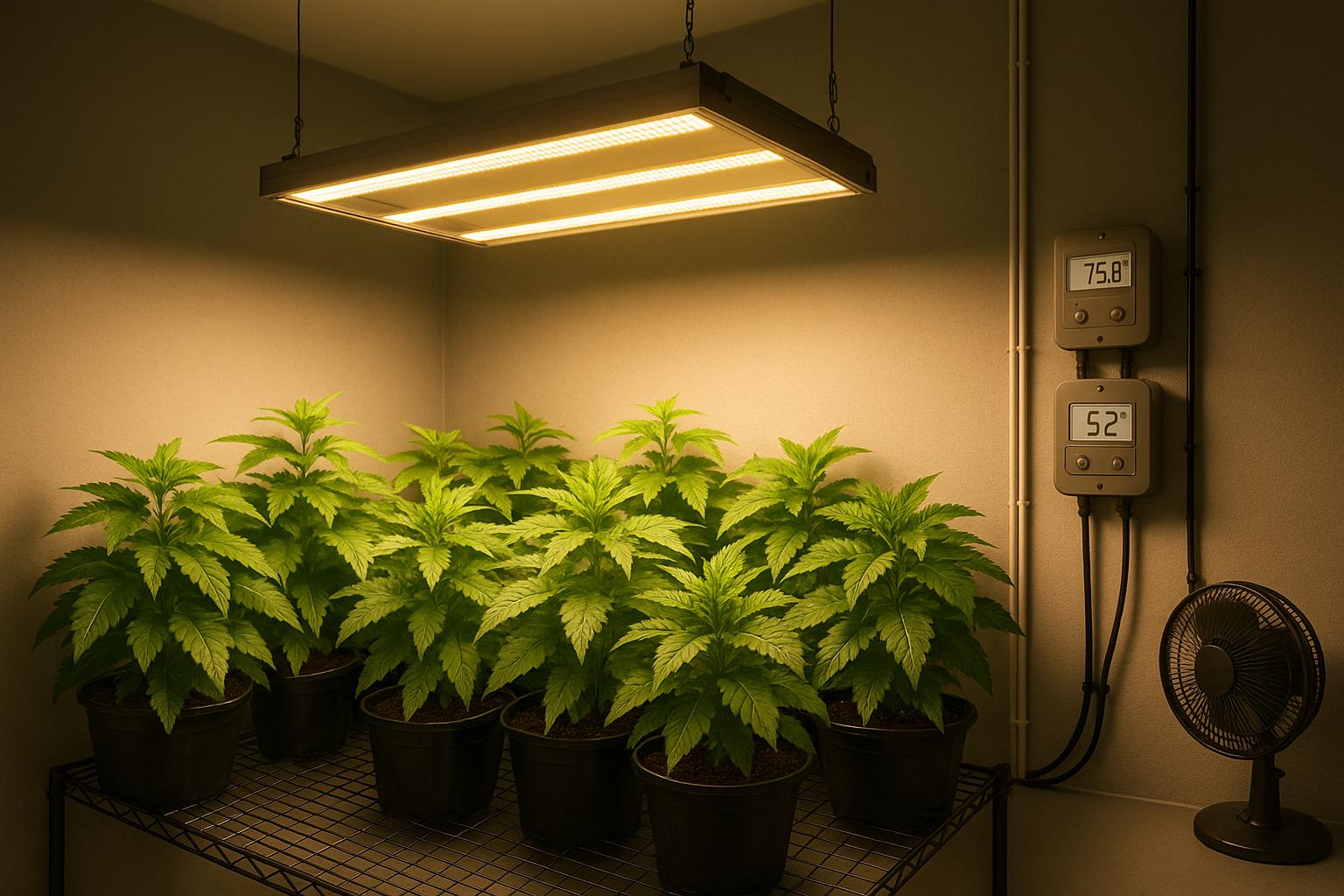
Powdery mildew is a fungal infection that starts as small white or gray spots on cannabis leaves, often in shaded or humid areas. It spreads quickly, disrupting photosynthesis, reducing yield, and potentially ruining buds. Early detection is key to preventing widespread damage.
Key Takeaways:
- Early Signs: Tiny, flour-like white or gray spots on fan leaves, especially in crowded or lower canopy areas.
- Progression: Spots expand into irregular, powdery blotches that can spread to stems, petioles, and buds.
- Testing: Use the wipe test (removable powder) or misting test (disappears when wet, reappears when dry) to confirm mildew.
- Prevention: Maintain 45–55% humidity during flowering, ensure proper airflow, and avoid overhead watering.
- Action Steps: Remove affected leaves, adjust growing conditions, and consider mildew-resistant cannabis strains.
Early action within the 5–7 day window can save your crop. Regular inspections and maintaining optimal growing conditions are your best defense.
How To Identify and Control Powdery Mildew on Cannabis Plants
Visual Signs of Early-Stage Powdery Mildew
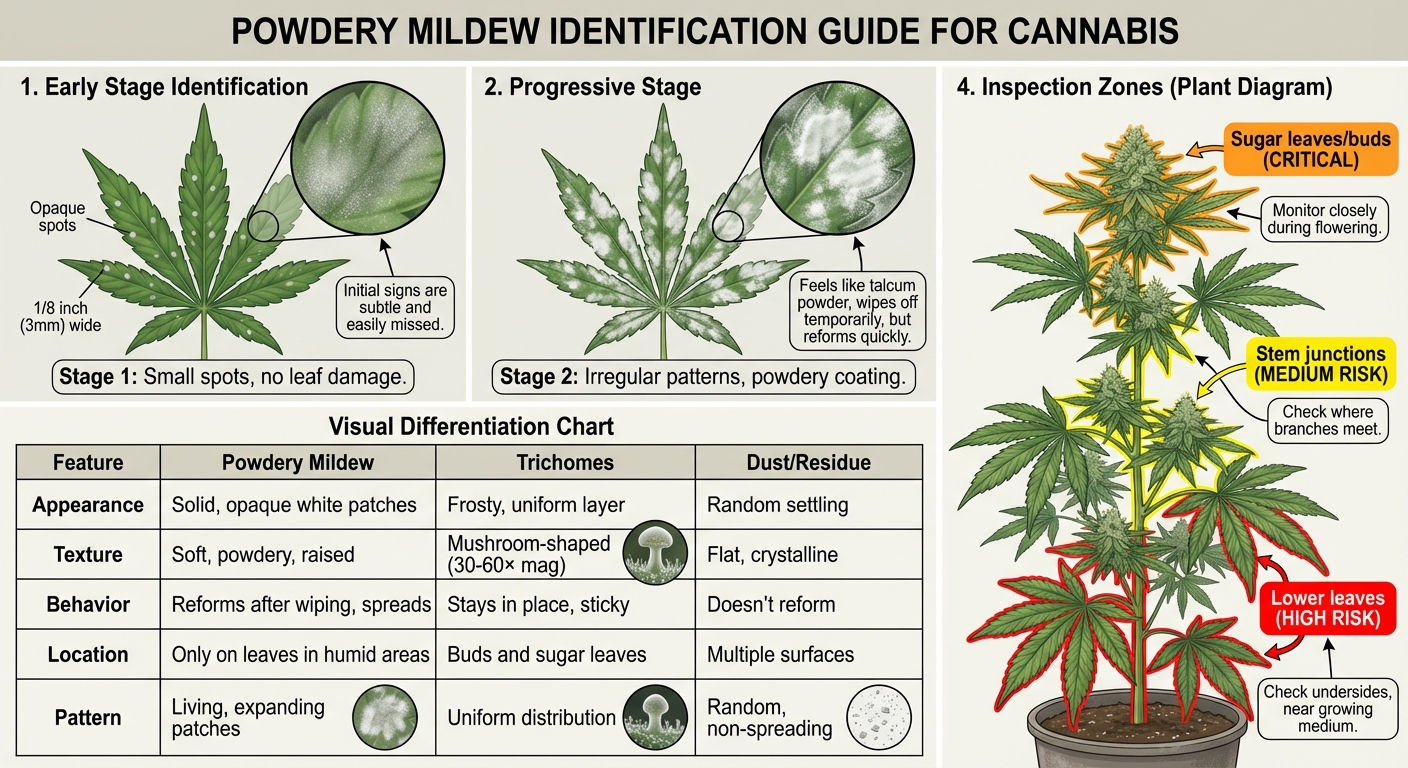
Visual Guide to Identifying Powdery Mildew on Cannabis Leaves
Small White or Gray Spots
One of the first signs of powdery mildew is the appearance of tiny, round white or light gray spots on cannabis leaves. These spots resemble a light dusting of flour and are usually just a few millimeters wide (around 1/8 inch) when they first show up. You’ll often find them on large fan leaves in the shaded, crowded parts of your canopy where airflow is limited. At this stage, the leaves generally stay green and healthy without showing much yellowing or curling. Over time, these spots start to grow and form irregular patterns, making the infection more noticeable.
Powdery Coating in Irregular Patterns
As the infection develops over several days, those small spots begin to expand and merge into larger, irregular blotches. This creates a patchy, uneven coating that might remind you of chalky fingerprints or flour splashes. The mildew feels like a soft, talcum-like powder sitting on the leaf's surface rather than being embedded in it. Lightly rubbing the surface might remove some of the powder temporarily, but it quickly reappears. The infection usually starts on the upper side of the leaves and can spread to the undersides, stems, and nearby foliage as airborne spores travel.
Telling Powdery Mildew Apart from Trichomes and Residue
It’s important to distinguish powdery mildew from other similar-looking substances. Trichomes, for instance, form a frosty, uniform layer on cannabis buds and sugar leaves. Powdery mildew, on the other hand, appears as solid, opaque white patches that sit on top of the trichomes and leaf tissue, dulling the plant’s natural sheen. Under 30–60× magnification, trichomes look like tiny, mushroom-shaped structures, while mildew appears as a matted, web-like or cottony growth without defined gland heads.
Dust and other residues in the grow room can also create confusion, but they tend to settle randomly across multiple surfaces, not just on the leaves. Unlike mildew, dust doesn’t reform once wiped away and doesn’t spread in persistent patterns. Powdery mildew, however, forms living, expanding patches that grow in size and number over time as it continues to produce spores. If you notice the white coating only on plant leaves - especially in humid, crowded conditions - while nearby surfaces like pots, walls, or equipment stay clean, it’s a strong sign of fungal growth rather than dust.
Similarly, nutrient salt buildup can appear on leaves but usually forms along the edges or where solutions have dried, creating sharp-edged, crystalline films rather than a soft, fuzzy coating. Using angled lighting, such as a flashlight or LED, can help you see the raised, powdery texture of mildew, which stands out against the smoother leaf surface.
Where to Check for Powdery Mildew on Your Plants
Once you spot the visual signs of powdery mildew, it’s time to examine specific areas of your plants where this fungus is most likely to develop.
Lower Leaves and Undersides
Powdery mildew often makes its first appearance on lower and inner fan leaves. These spots are close to the growing medium, where humidity tends to be higher. The upper canopy can block light and airflow, creating damp, shaded microclimates that are perfect for fungal growth. The undersides of leaves, in particular, retain moisture, making them a prime target for mildew spores to settle and germinate. Outdoor plants exposed to morning dew or indoor plants experiencing condensation are especially vulnerable. During inspections, focus on the inner canopy and look for small, white or gray powdery spots. A small flashlight, angled across the leaf surface, can help you spot faint patches that might not be immediately visible.
Stem Junctions and Petioles
As the mildew spreads - usually within one to two weeks - it often moves from the leaves to other plant parts. Spores released by the fungus can land on nearby areas like petioles (the stalks connecting leaves to branches) and stem junctions (where branches meet). These spots are prone to trapping still air and moisture, creating ideal conditions for infection. Look for circular white spots or streaks that resemble chalk. While you might be able to wipe them away temporarily, they’ll likely return if the moisture issue isn’t resolved. Pay extra attention to dense areas where multiple branches intersect, as these spots often harbor stagnant air. Also, check around clusters of buds for early signs of mildew.
Sugar Leaves and Buds in Flowering Stage
As your plants progress from mid-flower to late flower, the sugar leaves - the small leaves nestled around buds - become a critical area to monitor. These leaves are tightly packed, restricting airflow and trapping humidity, which encourages mildew growth. This stage is particularly tricky for indoor growers in the U.S., where temperature and humidity fluctuations during light cycles can lead to repeated condensation events. Powdery mildew at this stage usually appears as irregular, chalky patches that smear when wiped, similar to flour. If mildew reaches the buds, it can affect the cannabinoid and terpene profiles and may even make the flowers unsafe for consumption. Any affected buds should be removed immediately, and the surrounding area should be cleaned thoroughly to prevent further spread.
Environmental Conditions That Promote Powdery Mildew
Knowing the conditions that encourage powdery mildew can help you take action before it becomes a problem. This fungus thrives in environments commonly found in both indoor and outdoor cannabis grows across the U.S. Here’s a closer look at the factors that create the perfect setting for powdery mildew.
High Humidity
Powdery mildew spores germinate when relative humidity exceeds 55–60%. Consistently high humidity, especially in dense plant canopies, allows spores to spread quickly. For indoor setups, many growers aim for 55–65% RH during the vegetative stage and 45–55% RH during flowering. If there’s a history of mildew issues, sticking to the drier end of these ranges is safer. To monitor humidity, place digital hygrometers at key spots like canopy level, near vents, and in corners to detect humid areas. Tools like dehumidifiers, proper ventilation, and removing standing water are essential for keeping RH in check.
Poor Airflow and Temperature Fluctuations
Stagnant air creates humid pockets within the canopy, giving spores a chance to settle instead of dispersing. Dense foliage can trap moisture and shade lower parts of the plant, making things worse. In small grow tents (e.g., 3×3 ft or 4×4 ft), it’s common to use an inline exhaust fan to exchange air every 1–3 minutes, along with oscillating fans positioned above and below the canopy to maintain airflow.
Powdery mildew thrives in moderate temperatures between 65–80°F (18–27°C). The risk increases when warm days are followed by cooler nights because falling temperatures can spike relative humidity - sometimes exceeding 70% during lights-off periods. To reduce this risk, aim to keep lights-off temperatures only 5–10°F lower than lights-on temperatures.
Water Droplets on Leaves
Water left sitting on leaves creates a moist environment that encourages spore germination. Practices like overhead watering, heavy foliar spraying near lights-off, or allowing condensation from tent walls or ducting to drip onto plants can leave leaves wet for hours, increasing the risk. To minimize this, water at the soil level and avoid wetting the foliage unless applying targeted treatments. Leaves should dry within 1–2 hours to prevent mildew from taking hold.
sbb-itb-1add288
Testing Methods to Confirm Powdery Mildew
If you notice suspicious white or gray patches on your cannabis leaves, it’s important to determine whether they’re caused by powdery mildew or something harmless like dust or residue. Luckily, a few quick and easy tests can help you confirm the presence of powdery mildew, allowing you to take action before the problem spreads.
The Wipe Test
The wipe test is one of the simplest ways to check for powdery mildew. Gently rub the white spot with a clean, dry finger or a cotton swab. If the substance wipes off easily, like flour, and reveals a healthy green leaf underneath, it’s likely powdery mildew. On the other hand, trichomes will stay in place, and sticky residues from foliar sprays will smear rather than dust off.
After performing the test, treat the area as contaminated. Dispose of the cotton swab or any other material you used in a sealed bag, wash your hands thoroughly, and avoid touching other plants. To prevent spores from spreading, conduct the test away from fans or areas with strong airflow.
The Misting Test
Another method is the misting test. Lightly spray the suspicious spot with clean water. If the white layer flattens and temporarily disappears, only to reappear as the leaf dries within 15–30 minutes, it’s a strong indicator of powdery mildew.
Keep in mind that mineral deposits or dried nutrients may become more noticeable when wet, but they won’t mimic the reappearing pattern of mildew. Trichomes, meanwhile, will remain shiny and unaffected. Avoid using this test on dense buds during late flowering, as the added moisture can increase the risk of bud rot. Instead, test nearby fan leaves or combine this method with the wipe test for better accuracy.
Tools for Inspection
For a closer look, magnification tools can be incredibly helpful. A 10–30× jeweler’s loupe or handheld magnifier can help you distinguish powdery mildew’s cobweb-like fungal structure from trichomes, which are upright and bulbous. A clip-on phone microscope is another handy option, allowing you to capture detailed images for monitoring the infection or sharing with other growers for feedback.
In addition to visual tests, monitoring your growing environment can provide valuable clues. Use a digital hygrometer and thermometer at canopy level to track conditions. Powdery mildew thrives when relative humidity consistently exceeds 55–60% or when there are large temperature swings between day and night. By recording these conditions over several days, you might spot patterns like nightly humidity spikes or areas with poor airflow. Adjusting your ventilation or humidity controls based on these insights can help prevent future outbreaks.
Choosing Disease-Resistant Strains to Prevent Powdery Mildew
In addition to managing growing conditions, selecting strains that are resistant to powdery mildew can significantly reduce the likelihood of outbreaks. Once you've become skilled at spotting early signs of the disease, incorporating resistant genetics into your grow can provide an extra layer of protection.
Starting with strains bred for disease resistance is one of the best ways to combat powdery mildew. These strains are better equipped to handle infections, often showing fewer symptoms and slower spread while maintaining their strength even under stressful conditions.
When shopping for seeds, keep an eye out for terms like "powdery mildew resistant", "mold resistant", or "suitable for humid conditions." Breeders in wetter climates, such as coastal areas, often prioritize powdery mildew resistance by selecting plants that thrive under high humidity while removing those that are more susceptible. Strains with open structures, vigorous growth, and fast maturation are particularly beneficial. Open canopies allow better airflow and quicker drying, which helps reduce moisture retention and the risk of mildew.
A resource like Cannabis Seeds Directory can simplify your search by offering access to a variety of genetics from trusted seed banks and breeders. While this platform provides a convenient starting point, detailed information about resistance traits is usually available directly from breeders. This lets you choose strains that match your specific growing conditions - whether it’s an indoor setup with controlled humidity levels (around 45–55% RH) or an outdoor grow in a humid coastal environment. Plus, sourcing seeds from reputable breeders ensures you get stable genetics and reliable customer support.
Combining resistant genetics with effective environmental controls is key. Over time, you can observe which strains perform best in your grow space and adjust your selections accordingly. While some highly resistant strains may yield slightly less or have a less diverse terpene profile than others, modern breeding advancements have made it possible to find cultivars that offer strong resistance alongside impressive potency and flavor. By integrating these genetics with consistent monitoring, you can maintain a robust and healthy crop.
Conclusion
Catching those small white or gray spots early can make all the difference in saving your crop. These spots are the first sign of trouble, and you’ve got a tight 5–7 day window before the colonies multiply and release spores into the air. Once that happens, the infection spreads fast, blocking photosynthesis and reducing bud quality.
To stay ahead, use the detection methods discussed earlier and take quick action. Regularly inspect your plants and maintain proper humidity, airflow, and watering practices. If you notice early symptoms, remove infected leaves right away and adjust environmental controls to limit the spread. Quick tests like the wipe or misting test can help confirm infections on the spot.
For an added layer of defense, consider planting disease-resistant strains from trusted breeders. If you’re looking for reliable options, check out Cannabis Seeds Directory, a helpful resource for finding breeders and strains designed to resist common diseases.
FAQs
How can I tell the difference between powdery mildew and trichomes on cannabis leaves?
Powdery mildew shows up as a white, dusty coating on cannabis leaves and is caused by a fungal infection. On the other hand, trichomes are tiny, crystal-like structures that naturally occur on the plant. They can appear clear, milky, or amber and are most abundant on the buds and some leaves.
The main difference? Powdery mildew can be wiped off easily and feels like dust, while trichomes are sticky and an essential part of the plant's anatomy. Still unsure? Look for other mildew indicators like yellowing leaves or a musty odor - neither of which are linked to trichomes.
What environmental conditions help prevent powdery mildew on cannabis plants?
To keep powdery mildew at bay, focus on maintaining low humidity and ensuring proper air circulation around your plants. Give your plants enough space to prevent moisture buildup, and aim to keep the temperature between 70–80°F (21–27°C). These steps help create conditions where mildew struggles to thrive, promoting healthier cannabis plants.
What are the best ways to select cannabis strains resistant to powdery mildew?
When selecting cannabis strains that can stand up to powdery mildew, it’s smart to start with genetics known for their toughness against mold. Strains developed in humid regions or specifically labeled as resistant to diseases often have a natural edge in battling conditions that encourage mildew growth. Indica-dominant hybrids and some landrace strains are also known to offer stronger resistance.
You can also turn to resources like Cannabis Seeds Directory to browse a wide range of strains from trusted breeders. Pay attention to detailed strain descriptions and user reviews that mention resistance to common plant diseases. Pairing the right strain with effective environmental management can go a long way in keeping powdery mildew at bay.